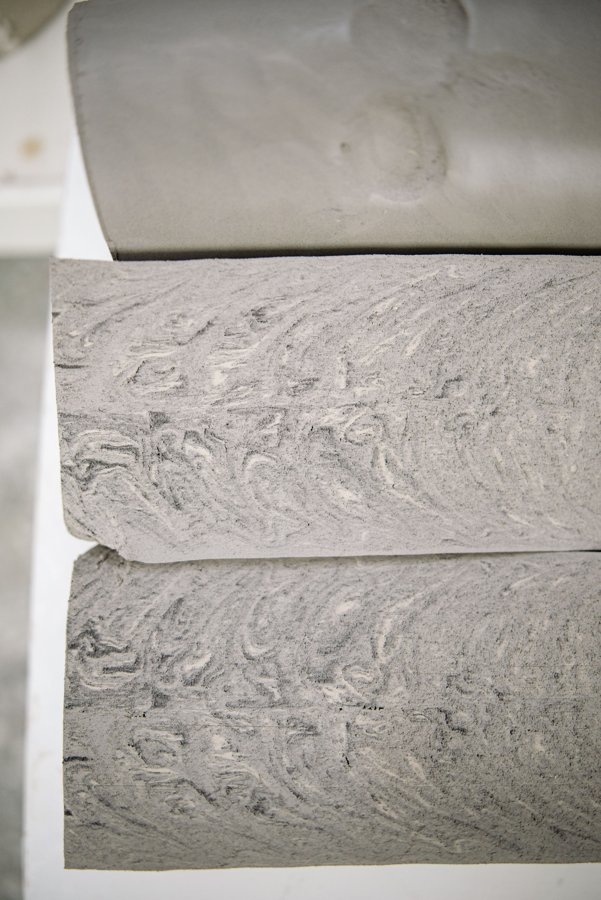
A clay body is an engineered mixture of clays and other minerals formulated for a specific way of working and firing, not a single natural material dug from the ground. Potters distinguish "a clay," meaning a raw mineral deposit, from "a clay body," meaning a recipe blended (usually by a manufacturer) to hit a target combination of workability, fired color, strength, and firing temperature.
¶ Clay minerals and geology
At the mineral level, clay is made of hydrous aluminum phyllosilicates: aluminum and silicon ions bonded into microscopic, flat plates, typically smaller than two micrometers across. Most pure clay minerals are white or near-white; the range of natural colors seen in raw clay comes from impurities carried along with them, chiefly iron oxide. Three mineral families account for most clay: kaolinite (the mineral behind kaolin), illite, and the smectite group (including montmorillonite). Roughly thirty distinct "pure" clay minerals are recognized, but a natural clay deposit is almost always a mixture rather than one mineral alone.
Clay minerals form through the prolonged chemical weathering of feldspar-bearing rock, and which mineral results depends heavily on climate and the parent rock: acidic weathering of granite in a warm climate tends to produce kaolinite, for instance, while the same rock weathering under alkaline conditions tends toward illite. Geologists distinguish primary clay, which stays at the site where it formed (kaolin is the standard ceramic example), from secondary clay, which erosion and water transport carry away and redeposit elsewhere, a process that grinds the particles finer and picks up organic matter and other minerals along the way (ball clay is the standard ceramic example). That transport history is exactly why kaolin stays coarse and pure while ball clay ends up finer-grained and more plastic; see ball clay for what that difference actually does to a clay body.
Plasticity itself comes directly from that flat, plate-like particle shape. Water forms a thin film between the plates, letting them slide across one another under pressure while still clinging together, which is what lets a wet clay body hold a new shape instead of crumbling or simply flowing. Firing removes that water permanently and fuses the plates together with real chemical bonds, which is also why a fired piece can never be reworked and rehydrated back into a workable clay the way a dry, unfired piece can.
¶ Composition
Most clay bodies combine a few functional ingredients: a plastic clay component (often ball clay) for workability, kaolin for whiteness and refractoriness, feldspar as a flux to help the body vitrifyTo become glassy and non-porous through heat: the clay particles partially melt and fuse together, closing the body's pore structure. Full vitrification is what makes stoneware and porcelain watertight without a glaze. at a reasonable temperature, and silica for structure and stability. Many bodies also include grog (pre-fired, crushed clay) or sand for texture, thermal shock resistance, or to reduce shrinkage and warping.
¶ Specialty and additive bodies
Beyond the standard structural recipe, a few purpose-built variants come up often enough to be worth knowing by name. Paper clay has processed paper fiber mixed directly into the wet clay; the fiber burns away completely during firing, but while the piece is still raw it adds real tensile strength, lets thin or bridged forms hold together that would otherwise sag or crack, and makes the fired-away pockets left behind a body that dries lighter and somewhat more forgiving of uneven drying. Casting bodies are formulated specifically to be deflocculated into a fluid, pourable slip for mold casting, rather than to be plastic enough to throw or hand-build (see slip). Raku bodies lean heavily on grog for the thermal shock resistance raku's extreme, rapid temperature swings demand, the same way flameware bodies do for direct stovetop use. Fireclay and other refractory bodies, formulated to survive repeated firing to very high temperatures with minimal shrinkage or softening rather than for plasticity or fired color, are what kiln shelves, kiln bricks, and other kiln furniture are themselves made from, not just what goes through the kiln. Some bodies also take a body stain or colorant, a ceramic pigment mixed directly into the clay rather than applied afterward as a glaze or slip, to color the clay itself rather than just its surface.
¶ Common types
| Body | Typical fire range | Absorption when mature | Plasticity | Fired color |
|---|---|---|---|---|
| Earthenware | Cone 06–04 | ~5–15% | Most plastic, most forgiving | Red, orange, buff, or white |
| Stoneware | Cone 4–10 | Low single digits | Moderate | Grey, buff, brown |
| Porcelain | Cone 6–10+ | Often <1% | Least plastic, most demanding | White, translucent when thin |
- Earthenware: low-fire, stays porous even when fully fired unless glazed, often red or buff from iron content, generally the most plastic and forgiving to throw.
- Stoneware: mid- to high-fire, vitrifies to a dense, low-porosity body, typically grey, buff, or brown depending on iron and other mineral content.
- Porcelain: high-fire, kaolin-rich, fires white and can be translucent in thin sections when fully vitrified, but is generally less plastic and less forgiving on the wheel than stoneware.
¶ From raw material to workable clay
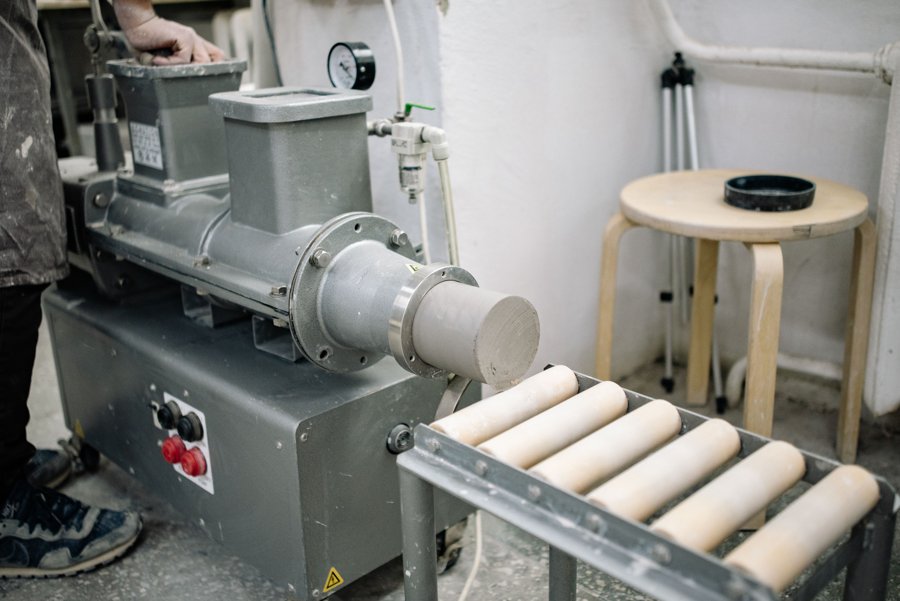
A commercial clay body does not arrive at a raw-material state and get used as-is. Manufacturers mix the dry ingredients with water to a workable consistency, then run the batch through a pug mill, a machine that mechanically compresses and extrudes the clay into a dense, continuous column, squeezing out trapped air pockets in the process (a de-airing pug mill applies vacuum for the same purpose even more thoroughly). Trapped air left in unpugged clay is a real hazard once a piece is fired, since a pocket of air trapped inside a solid wall can expand and cause the piece to crack or explode in the kiln. Many potters also let prepared clay rest, or age, for a period before use; aged clay generally works more plastically than freshly mixed clay, as bacterial activity and more complete particle hydration develop over the resting period (see plasticity).
Once workable, a body still has to be shaped into a piece; see Forming for wheel throwing, handbuilding, and slip casting, the standard methods for doing that.
¶ Properties that matter
A body's plasticity determines how it handles on the wheel or under hand-building pressure. Shrinkage happens twice: once as water leaves the clay during drying, and again as the body vitrifies during firing. Mismatched shrinkage between a body and an applied glaze or slip is a common source of cracking and warping. A body's fired absorption rate (how much water a fired, unglazed test bar takes on) is the standard way potters describe how vitrified it actually is. Every clay body also has its own thermal expansion behavior, which has to be compatible with whatever glaze sits on top of it; see crazing for what happens when it is not.
¶ Buying, storing, and reclaiming
Commercial clay body is usually sold pre-pugged, moist, and sealed in plastic, ready to use straight from the bag rather than mixed from dry powder by the individual potter (dry powdered clay, mixed with water in bulk, remains the norm for larger studios and manufacturers rather than individual buyers). Sealed and kept away from heat, moist bagged clay keeps for a long time, since nothing about it changes chemically until it is actually fired; the main risk in storage is simply drying out if a bag is left open. Clay scraps and trimmings, and dried-out clay that has gone unusably stiff, do not have to be thrown away: soaking dry scrap clay back down into a soft slurry and drying it back out to a workable consistency (on a plaster bat, which draws out excess water) reclaims it as usable clay again, the same body it always was, since nothing about ordinary drying and rewetting changes the clay chemically the way firing does.
¶ History
Raw, dug clay, used more or less as found, was the norm for most of pottery's history; the idea of a clay body as a deliberately engineered, tested recipe rather than a single natural material is comparatively recent. Josiah Wedgwood's development of creamware in England, starting around 1760, is a well-documented early case of that shift: working from Devon and Cornwall clays, Wedgwood ran an estimated 5,000 systematic trials, recording the exact materials and quantities behind each numbered test piece (in a private code, to protect the results from industrial rivals), before settling on the reliable, marketable body and glaze combination he began producing at Burslem around 1762 and later branded Queen's Ware after it won royal favor. That same systematic, tested, reproducible approach to formulating a body, rather than working whatever clay was locally at hand, is the direct ancestor of how commercial clay bodies are developed and tested today.
¶ References
- Wikipedia contributors. Clay. Wikipedia, The Free Encyclopedia. en.wikipedia.org
- Victoria and Albert Museum. Trial tray, Josiah Wedgwood and..., collection record. collections.vam.ac.uk
- Photo by Yan Krukau, via Pexels, Pexels License (resized and re-compressed from the original).
- Photo by Yankrukov, via Pexels, Pexels License (resized and re-compressed from the original).