Thermal shock resistance is a fired ceramic body's ability to withstand a rapid or uneven change in temperature without cracking. It is a distinct property from the glaze-fit problems behind crazing and shivering: those come from a steady-state mismatch between two bonded, already-cooled layers, while thermal shock failure happens in the moment a piece is heated or cooled unevenly, glaze or no glaze.
¶ Mechanism
When part of a fired piece heats or cools faster than the rest, usually because of a sudden temperature change (a hot piece set on a cold surface, or a cold piece put straight into a hot kiln), the heated and unheated regions try to expand or contract by different amounts at the same time. Because the piece is one continuous rigid body, that difference creates internal stress right at the boundary between the two regions. Fired ceramic is brittle, so past a certain point that stress is relieved by cracking rather than by the material flexing to absorb it.
¶ What improves it
A coarser body, especially one containing grog or sand, resists thermal shock better than a fine, dense one: the granules interrupt crack propagation and the more open pore structure gives the body some room to accommodate uneven expansion without immediately failing. Bodies with lower overall silica content also tend to resist thermal shock better, since the quartz inversion (a structural change silica undergoes around 573°C) adds its own contribution to expansion and contraction on top of ordinary thermal movement. Wall thickness matters too: a thinner, more uniform wall heats and cools more evenly than a thick one, reducing the temperature difference that drives the stress in the first place.
¶ Where it matters practically
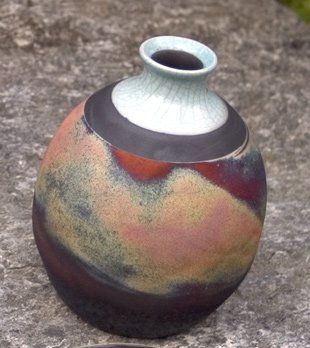
Raku firing is the clearest practical case: ware is pulled from the kiln still glowing hot and plunged into a reduction chamber, an extreme thermal shock that raku-specific clay bodies are formulated to survive. Flameware and other stovetop-safe ceramics are formulated for the same reason, since they have to tolerate direct, uneven heating in ordinary use rather than just a single controlled kiln firing. Cordierite, a magnesium-aluminum-silicate mineral with an unusually low thermal expansion of its own, is a common ingredient in flameware and kiln-shelf bodies specifically because a material that barely expands or contracts in the first place has little internal stress to relieve when it heats or cools quickly.
¶ References
- Hansen, Tony. "Cordierite Ceramics." Digitalfire Reference Library. digitalfire.com
- Photo by Kaszeta, via Wikimedia Commons, licensed CC BY-SA 2.5.
