Slip is clay suspended in water to a fluid, pourable or paintable consistency, distinct from a glaze in that it is unfired clay rather than a material formulated to melt into glass. Slip serves several different roles in pottery depending on how it is used.
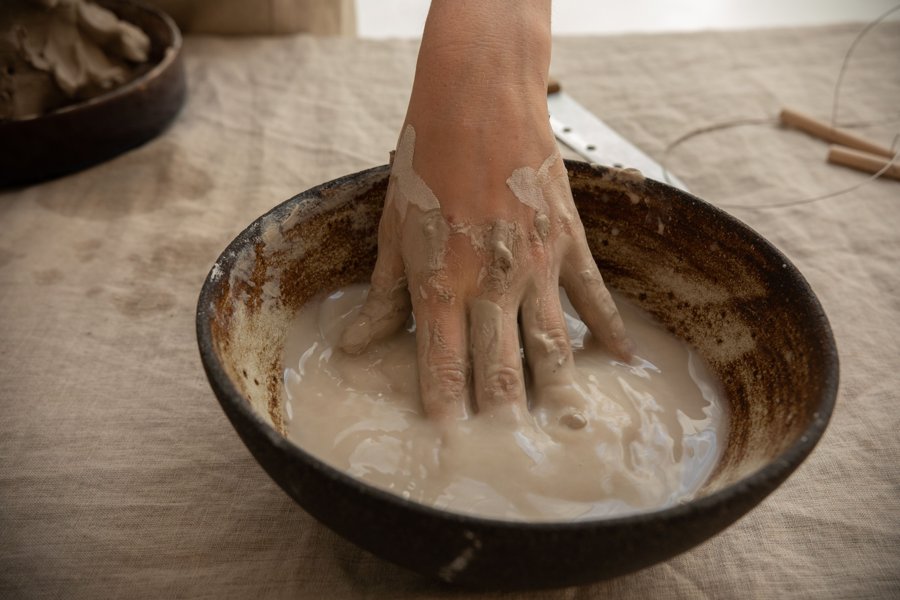
As an adhesive, slip is brushed onto two leather-hard clay surfaces before joining them, such as attaching a handle to a mug, where it helps the two pieces bond as they dry and shrink together. As a casting material, a thin, deflocculated slip is poured into plaster molds to build up cast ware, a process used heavily in production and figurine work. As a decorative surface, colored slip can be trailed, painted, dipped, or carved through (a technique called sgraffito) on leather-hard or bone-dry ware before firing, giving a range of surface effects distinct from what a glaze alone produces.
Deflocculation, used for casting slip specifically, adds a small amount of a chemical (commonly sodium silicate or a commercial deflocculant like Darvan) that lets a clay-and-water mixture stay fluid and pourable with much less water than would otherwise be needed, which matters directly for casting because less water in the slip means less water has to leave the piece again as it dries.
Because slip is essentially a more fluid version of a clay body, its shrinkage rate needs to be a reasonable match for whatever it is applied to, for the same reasons a glaze's fit needs to match the body underneath it.
¶ Slip vs. engobe
The terms are often used loosely, but a plain slip and an engobe are chemically different: a slip is essentially just clay and water, while an engobe adds flux and other materials to that base, giving it a lower clay content and letting it be formulated more deliberately for color and opacity. That formulation also changes when each can be applied: a plain slip generally needs to go on wet-to-leather-hard greenware, matching its shrinkage to a body still shrinking itself, while an engobe's added flux content means it can also be applied to already-bisqued ware, closer to how an underglaze is used.
¶ References
- Hansen, Tony. "Engobe." Digitalfire Reference Library. digitalfire.com
- Photo by Monstera Production, via Pexels, Pexels License (resized and re-compressed from the original).