Kaolin (also called china clay) is a white-firing primary clay, mined at or close to the site where it formed rather than transported and weathered further the way secondary clays like ball clay are.
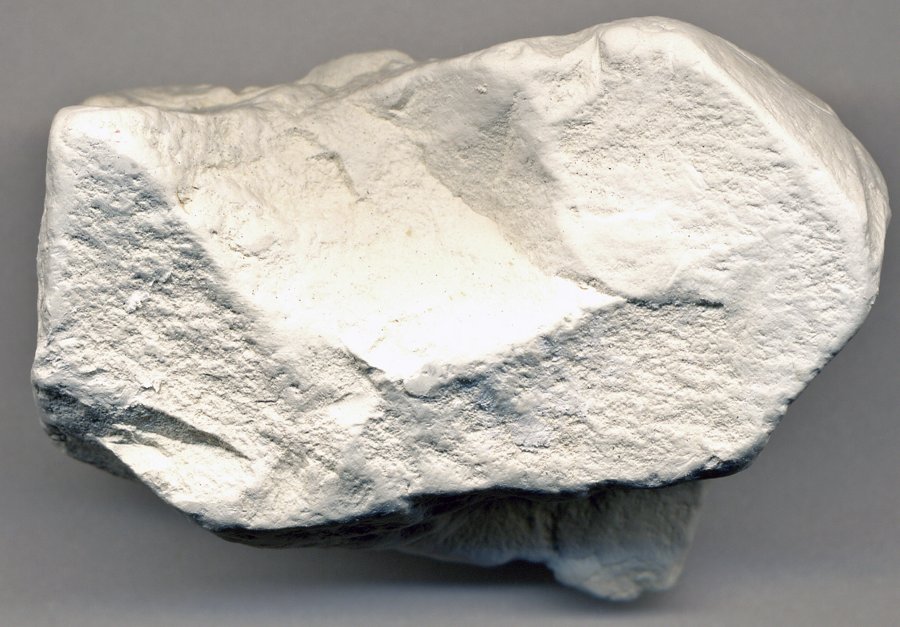
That short geological history leaves kaolin's particles coarser and its structure purer, which is exactly why it fires white: it carries far less of the iron and organic matter responsible for the buff, red, and grey tones common in other clays.
The same coarse particle structure that keeps kaolin pure also makes it far less plastic on its own than a secondary clay, so a body built from kaolin alone is typically too short (insufficiently workable) to throw or hand-build comfortably. Porcelain bodies solve this by combining kaolin with a smaller, carefully balanced amount of ball clay and other plasticizing materials, trading some workability for the whiteness and translucency kaolin makes possible.
In glaze chemistry, kaolin also functions as a source of alumina, contributing to the stabilizer role described in glaze chemistry, on top of its role as a clay body ingredient.
Calcined kaolin is kaolin that has already been fired once, at a temperature high enough to drive off its chemically bound water but well below vitrification, then ground back into a powder. Because that shrinkage and water loss already happened before it goes into a recipe, calcined kaolin contributes alumina and structure without adding to a body's shrinkage or a glaze's tendency to crawl or craze from excess raw-clay content, which is why it shows up in recipes where kaolin's chemistry is wanted but its raw-material behavior is not.
¶ Name and history
Kaolin's name comes from Gaoling ("high ridge"), a village near Jingdezhen in Jiangxi, China, where the material was mined and used in Chinese porcelain production for centuries before becoming known in the West; the material was recorded there under the name "Gaoling clay" by the early 17th century. The Jesuit missionary d'Entrecolles, whose 1712 letters from Jingdezhen also carried Chinese porcelain manufacturing methods to Europe (see Porcelain's history), is credited with introducing the term into European languages, anglicized to "kaolin." It is unusual among minerals for being named after the specific place it was mined rather than its chemical composition.
¶ References
- "Kaolin." Online Etymology Dictionary. etymonline.com
- Photo by James St. John, via Wikimedia Commons, licensed CC BY 2.0 (resized and re-compressed from the original).
