A raku kiln is a small, fast-firing kiln built around a firing style in which ware is pulled out while still glowing hot, rather than left to cool inside the kiln the way most other firings are. That rapid removal, and the reduction or smoking step that typically follows it, is what defines raku as much as the kiln itself.
¶ How it works
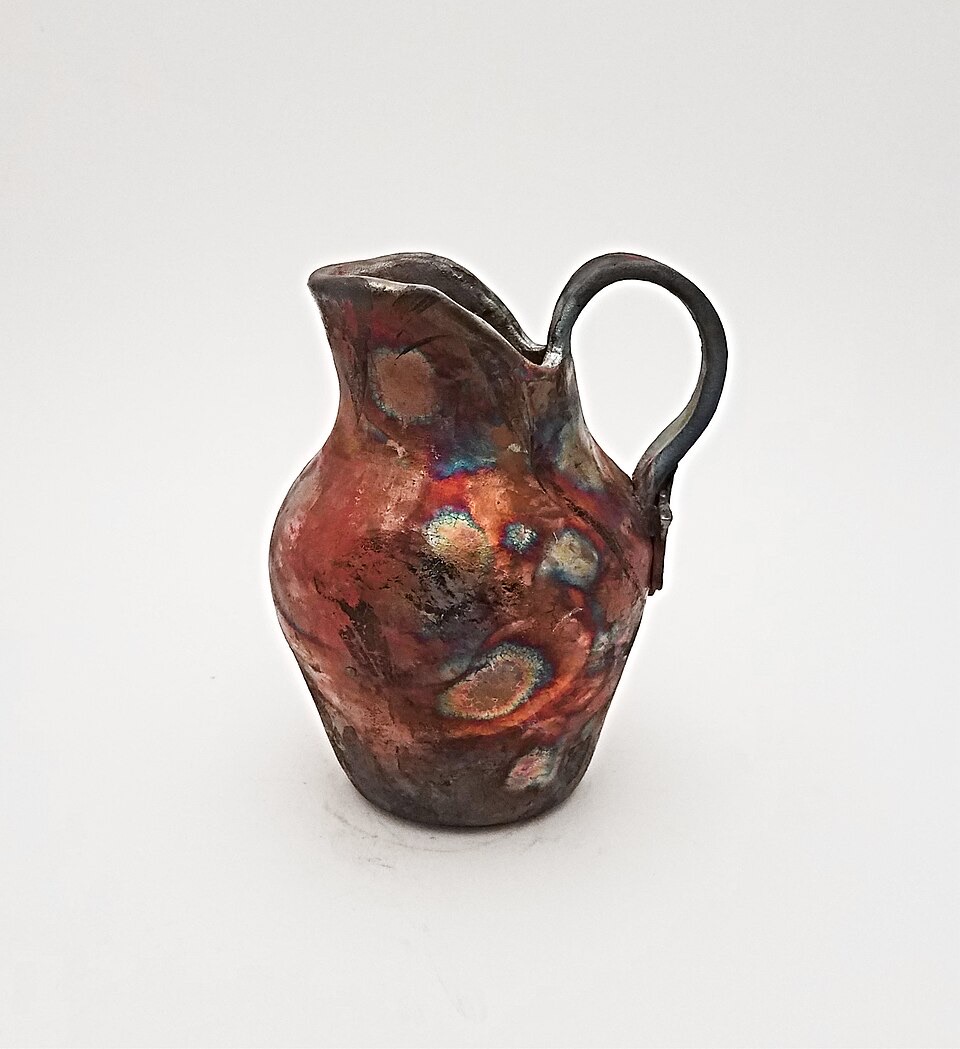
A raku kiln is generally small and lightly built, often lidded rather than fully enclosed, so it can reach firing temperature quickly and be opened safely mid-cycle. Once the glaze has matured, the still-glowing piece is lifted out with long tongs and placed into a separate reduction or smoking chamber, commonly a metal can packed with combustible material like sawdust or paper. The combustible material ignites on contact with the hot piece and is then sealed in with a lid, starving the chamber of oxygen; the resulting reduction atmosphere and the direct smoke contact both darken exposed, unglazed clay and can shift certain glaze colors, effects raku is specifically prized for.
¶ Practical considerations
Pulling a piece from full temperature into open air is an extreme, sudden thermal shock that an ordinary clay body would crack under, so raku firing requires a body specially formulated for thermal shock resistance, typically leaning heavily on grog content to survive the swing (see clay bodies). Because each piece is handled individually right out of the kiln rather than left to cool as part of a shared batch, raku firing suits small-scale, hands-on work far better than large production runs, and the smoking step's variability means, similarly to wood or salt firing, that the exact result on a given piece is not fully controllable in advance.
Naked raku is a variant that deliberately works against a normal glaze's job: a resist slip is applied under a specific glaze formulated to crack and lift away almost entirely during the post-fire smoking step, peeling off once cooled and leaving bare, smoke-blackened clay behind wherever the glaze released, with the resist layer's crackle pattern showing as the finished design.
¶ History
Raku originates in late-16th-century Kyoto, where the tea master Sen no Rikyū, developing the deliberately rustic, irregular wabi-cha aesthetic of the Japanese tea ceremony, commissioned the potter Chōjirō to make hand-formed, low-fired tea bowls unlike the wheel-thrown ware more typical of the period. Chōjirō's monochrome red and black bowls were granted the name "Raku" (楽, roughly "ease" or "enjoyment") by Toyotomi Hideyoshi, the ruler of Japan at the time, and the Raku family has continued the tradition across more than 450 years and, as of the early 21st century, sixteen generations. The fast, dramatic pull-and-smoke firing style practiced in Western studios today is a later adaptation of the name and general spirit of Japanese raku rather than a direct continuation of the original hand-built, wheel-free tradition, which remains its own distinct practice in Japan.
¶ References
- Encyclopaedia Britannica. "Raku ware." britannica.com
- Photo by Ruthann Hurwitz, "Colorful Handmade Raku Pottery Pitcher," via Wikimedia Commons, licensed CC BY-SA 4.0 (resized and re-compressed from the original).
