Porcelain is a high-fire, kaolin-rich clay body that fires white and, in thin sections, can become translucent once fully vitrified.
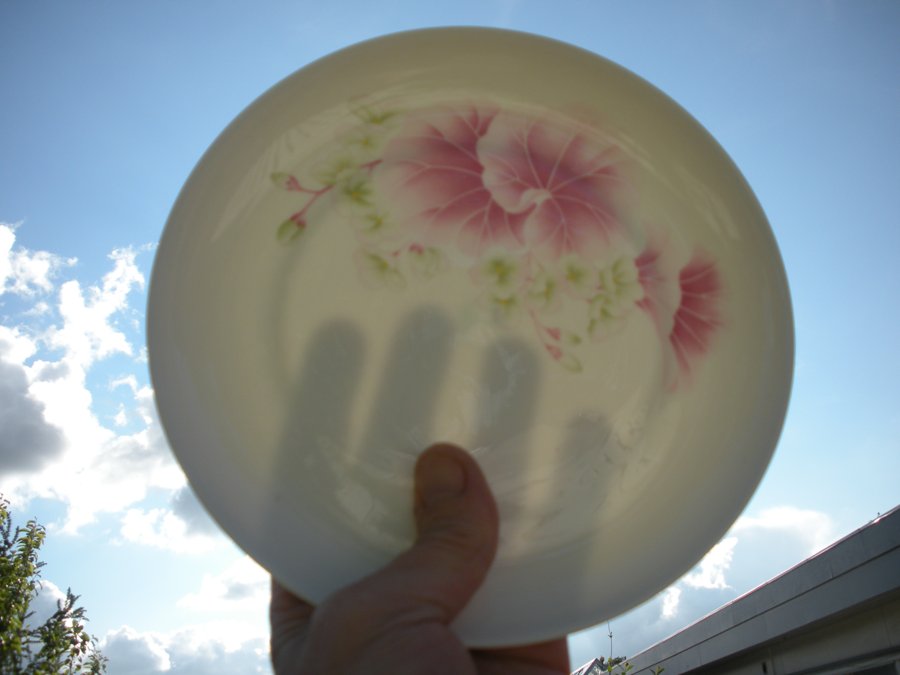
Its high kaolin content is what gives it that whiteness and translucency, but kaolin's coarse, low-plasticity particle structure also makes porcelain generally less plastic and less forgiving on the wheel than stoneware, demanding more careful, practiced handling to throw successfully.
Historically associated with Chinese ceramics dating back over a thousand years, porcelain became a defining material for fine tableware and sculptural work internationally, prized for the combination of strength, whiteness, and translucency a well-vitrified porcelain body achieves at high fire. Compared to earthenware, fully vitrified porcelain has very low water absorption and does not require glazing for water resistance, though it is almost always glazed for surface quality and decoration.
Because porcelain has a narrower firing range than a typical stoneware body before it starts to slump or warp, achieving consistent results with it generally demands tighter control over the firing schedule.
Not all porcelain is the same chemistry, and each variant below now has its own full article: Hard-paste porcelain is the original Chinese formula, built from kaolin, feldspar, and quartz alone, and the one Meissen eventually reproduced (see History below). Bone china, developed later in England, replaces part of that mixture with bone ash, lowering the firing temperature and improving chip resistance at some cost to translucency. Soft-paste porcelain, an earlier and cruder European attempt to imitate Chinese porcelain before the real formula was known, used glass and other fluxes to reach translucency at a lower temperature, but is generally weaker and less durable than either.
¶ History
Porcelain developed gradually in China over several centuries rather than appearing all at once. Proto-porcelain wares date to the Shang dynasty (1600–1046 BCE), and by the Eastern Han period (25–220 CE) these had developed into what is classified as true porcelain: high-fired, glazed ceramic with a white, vitrified body. By the late Sui and early Tang dynasties (581–907 CE), wares such as Ding ware had achieved the whiteness and translucency associated with porcelain today, and were already being exported to the Islamic world. Production became highly organized under the Song dynasty (960–1279 CE), with dragon kilns capable of firing tens of thousands of pieces in a single load. By the Ming dynasty (1368–1644 CE), the finest court porcelain concentrated in a single city, Jingdezhen, which remains the center of Chinese porcelain production today; Ming blue-and-white ware reached Europe via Portuguese traders from 1517 and Dutch merchants from 1598.
The European name porcelain comes from the Italian porcellana (cowrie shell), after a resemblance early traders saw between the shell's surface and the ceramic's. Imported Chinese porcelain became so prized in Europe that "china" became a synonym for porcelain itself in English. Early European attempts to reproduce it failed: 16th-century Portuguese traders brought kaolin samples home, but the manufacturing method itself remained unknown, and the Medici porcelain factory in Florence, the first serious European attempt, had little success. The breakthrough came in Saxony: working with the alchemist Johann Friedrich Böttger, the scientist Ehrenfried Walther von Tschirnhaus determined that the secret lay as much in firing temperature as in ingredients, and the first successful firing of a true hard-paste porcelain body from local kaolin came on 15 January 1708. Augustus the Strong, Elector of Saxony, formally established the Meissen porcelain factory on 23 January 1710, Europe's first, built on that discovery.
Meissen's formula did not stay secret for long: in 1712 the Jesuit missionary François Xavier d'Entrecolles published a detailed account of Chinese porcelain manufacturing methods, observed firsthand at Jingdezhen, back in Europe, and porcelain factories spread quickly afterward: Saint-Cloud and Vincennes (later Sèvres) in France, the Imperial Porcelain Factory in Saint Petersburg from 1744, and, in England, a wave of factories between 1743 and 1767 including Chelsea, Bow, and Worcester. English manufacturers eventually developed their own distinct variant, bone china, using bone ash in the body, which Josiah Spode refined into the form still produced today.
¶ References
- d'Entrecolles, François Xavier (1712/1722). Letters from Jingdezhen, published in Lettres édifiantes et curieuses de Chine par des missionnaires jésuites. The primary historical source itself for how Chinese porcelain manufacturing methods reached Europe, not a secondary account of it, found via Wikipedia's own citation. en.wikipedia.org
- Porcelain Manufactory Meissen. "History." The manufactory's own account of the Böttger/Tschirnhaus breakthrough, with more precise dates than this article uses (first firing of hard porcelain 15 January 1708; factory established 23 January 1710) — found via independent search, not through Wikipedia. meissen.com
- Wikipedia contributors. Porcelain. Wikipedia, The Free Encyclopedia. Still the source for the Shang/Han-dynasty origins and Jingdezhen's rise — Wikipedia's own footnotes for these point only to author surnames (Rawson) without full publication details resolvable from the article text alone. en.wikipedia.org
- Wikipedia contributors. Meissen porcelain. Wikipedia, The Free Encyclopedia. en.wikipedia.org
- Photo by Klausbo, via Wikimedia Commons, public domain (resized and re-compressed from the original).
