Wheel throwing is a forming technique in which a piece is shaped from a single lump of clay centered on a spinning potter's wheel, then opened and drawn upward into a wall of even thickness under continuous hand pressure. It produces round, radially symmetrical forms relatively quickly once the process is learned, and is the technique most commonly associated with pottery in general.
¶ How it works
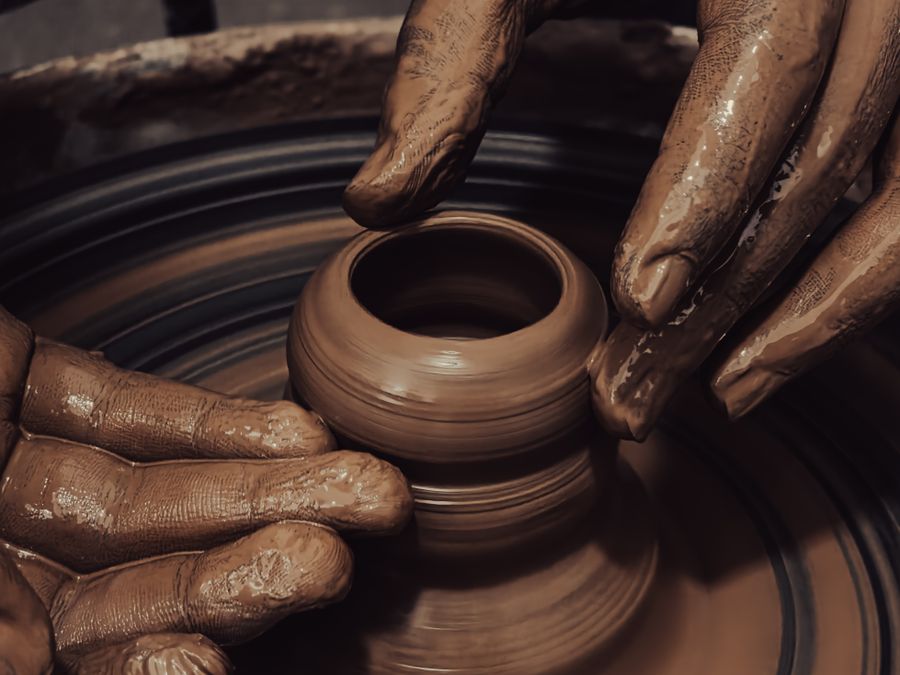
Centering comes first: the spinning clay is pushed and pressed until it runs true, with no wobble, since any off-center wobble at this stage carries through to every later stage and is far harder to correct once the form is opened. Coning, repeatedly pushing the clay up into a tall cone and back down into a low dome, is a common centering aid: the up-and-down compression helps even out any density or moisture inconsistency in the clay before the actual centering pressure is applied. The clay is then opened, the thumbs pressed down into the center to establish the floor and the beginning of the interior wall, followed by pulling (or raising), where the fingers compress and draw the wall upward and thinner in a series of even passes from base to rim. Once the basic form is raised, the piece can be shaped further by pressing the wall outward or inward, and the rim and profile refined before the piece is cut free from the wheel head with a wire. Once leather-hard, the piece is commonly returned to the wheel to be trimmed: excess clay is cut away from the base and foot with a trimming tool to even out the wall thickness and clean up the profile.
¶ Practical considerations
Wheel throwing needs a plastic, well-wedged, air-free body; a body that is too soft slumps under the pressure of pulling, and one that is too stiff resists centering and cracks rather than stretching. It excels at round, radially symmetrical forms produced repeatably and relatively quickly, which is why it is closely associated with functional production ware such as bowls, cups, and plates, but it is a poor fit for markedly asymmetrical, very large, or strictly rectilinear forms, where handbuilding is generally the better choice. A thrown piece is not necessarily left perfectly round: altering it, reshaping an already-thrown form by paddling, faceting, or otherwise pushing it out of round, combines the speed of the wheel with a shape the wheel alone cannot produce. For a run of several small pieces, throwing off the hump centers one large mass of clay once and throws each piece from its top, rather than centering a fresh lump for every single piece.
A kick wheel, spun and kept in motion by the potter's own foot against a heavy flywheel, is the older design and needs no power source; an electric wheel, driven by a motor with an adjustable foot-pedal speed control, is the more common design in studios today, since it frees both hands for throwing throughout and holds a steadier speed under load.
¶ References
- Hansen, Tony. "Throwing." Digitalfire Reference Library. digitalfire.com
- Photo by Tejas RS, via Pexels, Pexels License (resized and re-compressed from the original).