Stoneware is a mid-to-high-fire clay body family that vitrifies to a dense, low-porosity body at its maturity point, typically somewhere in the middle cone range depending on the specific clay; see cone charts for how that range is actually specified and measured. Fired stoneware color ranges from grey through buff to brown depending on iron and other mineral content in the clay.
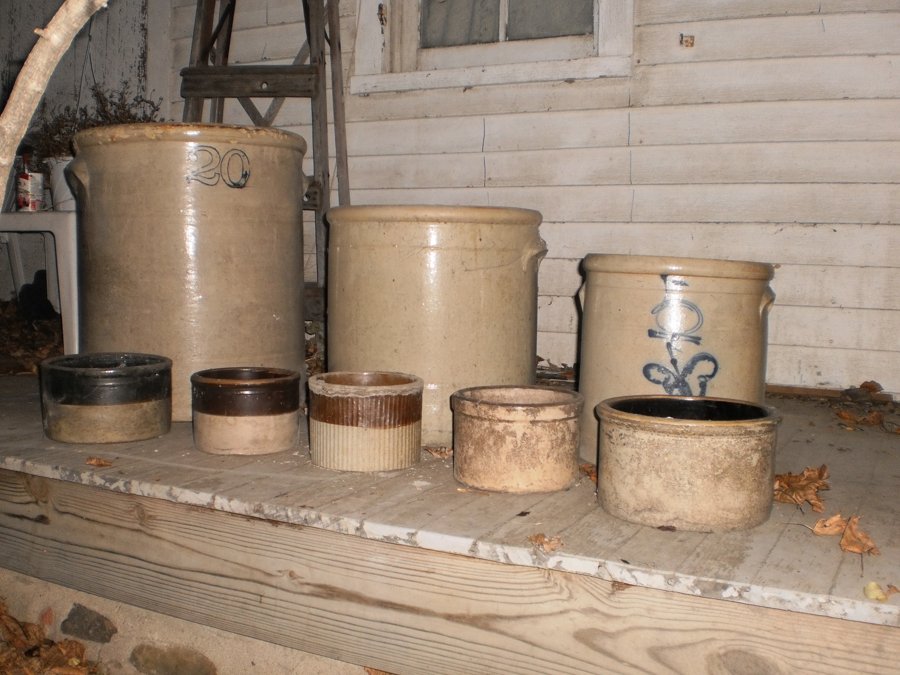
Stoneware sits between earthenware and porcelain in most practical respects: it fires hotter and vitrifies harder than earthenware, giving it much lower water absorption and greater durability, while generally remaining more plastic and more forgiving to work with on the wheel than porcelain. Because a properly vitrified stoneware body is already close to watertight, it does not strictly require a glaze for functional use the way earthenware does, though most stoneware is glazed for both surface quality and food safety in practice.
Stoneware's popularity in studio pottery owes a lot to this middle position: it tolerates a wider range of firing schedules and glaze chemistry than porcelain without the durability tradeoffs of earthenware. Stoneware bodies commonly mature somewhere in the cone 4 to cone 10 range, considerably hotter than earthenware and typically at or below porcelain's own firing range.
Salt-glazed stoneware, where sodium vapor introduced late in the firing reacts directly with the clay surface to form a thin glaze in place (see salt and soda kiln), is one of stoneware's oldest and most distinctive traditions, historically associated with German Rhineland pottery and, later, with American and British utilitarian ware like the crocks shown above.
¶ History
Ceramics fired hot enough to count as stoneware appear earlier and in more places than the mainstream European stoneware tradition might suggest: stoneware bangles were already being produced in the Indus Valley Civilization by around 2600 to 1900 BCE, and glazed stoneware was being made in China by around the 15th century BCE, the same technical leap forward (higher kiln temperatures reached through more efficient reduction firing) that also produced the earliest true glazes on a clay body (see Glaze). Chinese stoneware production expanded under the Han dynasty (206 BCE to 220 CE) and continued developing through the medieval period: Song-dynasty (960 to 1279 CE) Jian ware became prized for tea vessels, Longquan celadon was among the most widely traded stonewares of medieval China, and Ding ware approached porcelain-like refinement while remaining technically stoneware. Once true porcelain matured under the Ming dynasty, fine ceramic production in China shifted toward it, and stoneware settled into a more utilitarian role there, alongside continuing prestige traditions like Yixing clay teapots. Korean stoneware production dates back to at least the 5th century CE, and stoneware technology reached Thailand's Si Satchanalai and Sukhothai kiln sites from China as well. In Japan, where porcelain production only began around 1600 CE, stoneware traditions such as Oribe and Shino ware remained prized on their own terms for the tea ceremony's wabi-sabi aesthetic, valuing rough, spontaneous surfaces over porcelain's refinement.
European stoneware developed later and more slowly, held back by less efficient kilns and scarcer suitable clay. Proto-stoneware such as Pingsdorf ware was being made in the German Rhineland by around 1250 CE, with fully vitrified stoneware following by about 1325 CE. Salt-glazing, stoneware's most distinctive European finishing technique, originated in the Rhineland around 1400 CE and was perfected across Westerwald pottery towns, including Höhr-Grenzhausen, Siegburg, Cologne, and Raeren, by the late 15th century; Cologne-made stoneware, exported widely, dominated the European market for generations under the name Cologne ware. Salt-glazed stoneware reached England in the mid-to-late 17th century, brought in part by immigrant German potters; John Dwight's Fulham Pottery, founded in 1672, became one of its most significant English producers. The technique reached colonial America the same century and remained popular there through the 18th and into the 19th century, including the utilitarian salt-glazed crocks pictured above, though large quantities continued to be imported from Britain well into the 1800s. Josiah Wedgwood's late-18th-century stoneware innovations, including Jasperware, Cane Ware, and Rosso Antico, helped establish Britain as Europe's most prolific and inventive stoneware producer of the era. Stoneware remains in wide use today across industrial tableware, kitchenware, and studio pottery alike.
¶ References
- Kenoyer, Jonathan Mark (1998). Ancient Cities of the Indus Valley Civilization. Oxford University Press. p. 260. Primary source for Indus Valley stoneware bangles, found via Wikipedia's own citation. worldcat.org
- Blackman, M. James, et al. (1992). The Production and Distribution of Stoneware Bangles at Mohenjo-daro and Harappa as Monitored by Chemical Characterization Studies. Madison, WI: Prehistory Press. pp. 37–44. Same claim, a second primary source found via the same Wikipedia citation. worldcat.org
- Haselgrove, D.; Murray, J. (1979). "John Dwight's Fulham Pottery, 1672–1978: A Collection of Documentary Sources." Journal of Ceramic History 11. Primary source for Fulham Pottery's 1672 founding, found via Wikipedia's own citation.
- Hume, Ivor Noël (2001). A Guide to Artifacts of Colonial America. University of Pennsylvania Press. Primary source for the 1720s Yorktown, Virginia salt-glazed stoneware production, found via Wikipedia's own citation. worldcat.org
- Encyclopaedia Britannica. "Pottery: Stoneware, Glazing, Firing." A distinct, editorially-reviewed encyclopedia (not Wikipedia), confirming stoneware production in the Rhineland (Raeren) from around 1400 CE — found via independent search rather than through Wikipedia's own citation trail. britannica.com
- Wikipedia contributors. Stoneware. Wikipedia, The Free Encyclopedia. Still the source for early Chinese glazed stoneware and the Song/Ming-dynasty tradition. en.wikipedia.org
- Wikipedia contributors. Salt-glazed pottery. Wikipedia, The Free Encyclopedia. en.wikipedia.org
- Wikipedia contributors. History of pottery. Wikipedia, The Free Encyclopedia. en.wikipedia.org
- Photo by Daniel Christensen, via Wikimedia Commons, licensed CC BY-SA 3.0 (resized and re-compressed from the original).
