Earthenware is a low-fire clay body family that stays porous even when fully fired, unless it is glazed. Earthenware bodies mature at the lowest temperatures of the three main clay body families, typically well below where the clay would begin to vitrify, which keeps their absorption rate relatively high compared to stoneware or porcelain fired at their own maturity points.
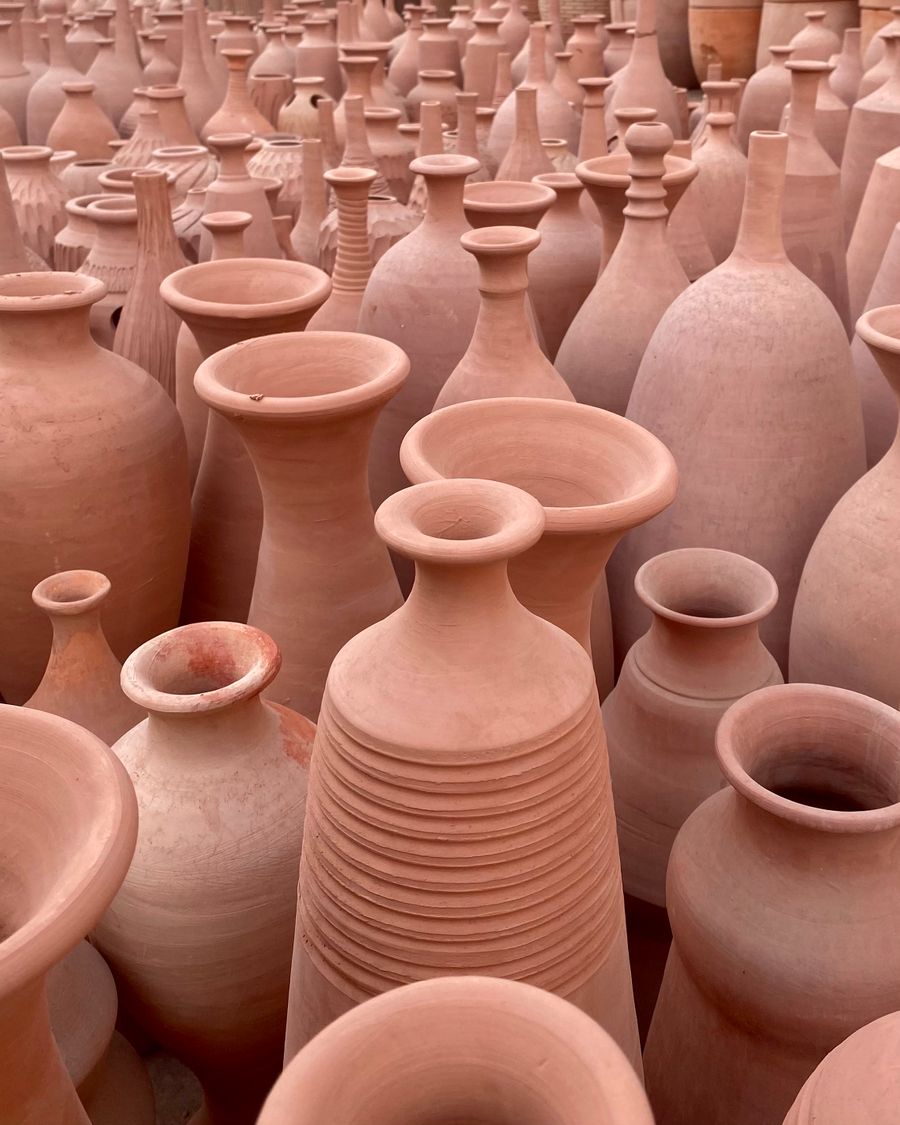
Earthenware clays commonly fire to warm reds, oranges, and browns from naturally occurring iron content, though white and buff earthenware bodies exist as well. Earthenware is generally the most plastic and forgiving clay body family to throw or hand-build with, which is part of why it has been the most widespread traditional pottery body across many cultures and historical periods.
Because unglazed earthenware remains porous, functional earthenware intended to hold liquid is glazed on at least its interior surface. That porosity, combined with earthenware's relatively low firing temperature, also makes it more vulnerable to frost damage and to absorbing moisture over time than a fully vitrified stoneware or porcelain body.
Earthenware bodies typically mature somewhere in the low-fire cone range, commonly around cone 06 to cone 04 (see cone charts for what those numbers mean); pushing an earthenware body much hotter than its intended range risks bloating or slumping rather than the improved vitrification a stoneware body would show. Terracotta, unglazed reddish earthenware, is the most familiar everyday example, from garden pots to roof tiles; majolica and faience are earthenware traditions built around an opaque, usually white, tin- or other-opacified glaze painted with colored decoration on top.
¶ History
The oldest known pottery vessels anywhere are earthenware, from Xianren Cave in Jiangxi, China, dated to roughly 20,000 to 19,000 years before the present. Since neither stoneware nor porcelain had been developed yet, every pottery tradition worldwide was necessarily earthenware for millennia afterward, including the pottery of ancient Egypt, Mesopotamia, Persia, and the Aegean, and later of Greece and Rome, where it remained the only body type in use. Stoneware first appeared in China by around the 15th century BCE (see Stoneware), but for a long time stayed a regional development rather than a global shift; outside East Asia, most pottery-making cultures continued working exclusively in earthenware for thousands of years more, and porcelain did not reach real production scale outside East Asia until the 18th century CE. Earthenware accordingly remained nearly all of European pottery up through the 17th century.
Tin-opacified glaze, applied over earthenware to give an opaque white ground for painted decoration, is the technical thread running through several of earthenware's best-known later traditions: it reached Islamic Spain and developed into Hispano-Moresque ware in the late Middle Ages, then spread into Italian Renaissance majolica and, further north, into French and Dutch faience and Dutch Delftware (see Glaze for the fuller technical and geographic story of tin-glaze's spread, which is a glaze-chemistry history rather than an earthenware-specific one). In 18th-century England, Staffordshire potters, Josiah Wedgwood most prominently, refined a pale, lead-glazed earthenware body known as creamware, popular enough across Europe to substantially displace tin-glazed earthenware in everyday use by the century's end. Earthenware remains in wide production today, both functional and decorative, alongside the stoneware and porcelain traditions that developed alongside and after it.
¶ References
- Wu, Xiaohong; Zhang, Chi; Goldberg, Paul; Cohen, David; Pan, Yan; Arpin, Trina; Bar-Yosef, Ofer (2012). "Early Pottery at 20,000 Years Ago in Xianrendong Cave, China." Science 336(6089): 1696–1700. The actual peer-reviewed discovery paper for the Xianren Cave date, found via independent search rather than through Wikipedia's own citation trail (which didn't resolve this one). science.org
- Wikipedia contributors. History of pottery. Wikipedia, The Free Encyclopedia. Still the source for the 15th-century-BCE Chinese glazed-stoneware claim. en.wikipedia.org
- Wikipedia contributors. Earthenware. Wikipedia, The Free Encyclopedia. en.wikipedia.org
- Photo by Sarah Farouk, via Pexels, Pexels License (resized and re-compressed from the original).