A glaze is a thin layer of glass, fused to the surface of a fired ceramic piece in the kiln. Glazes serve two distinct purposes at once: they make an otherwise porous clay body watertight and food-safe for functional ware, and they carry the color, texture, and surface quality most people associate with a finished piece's appearance.
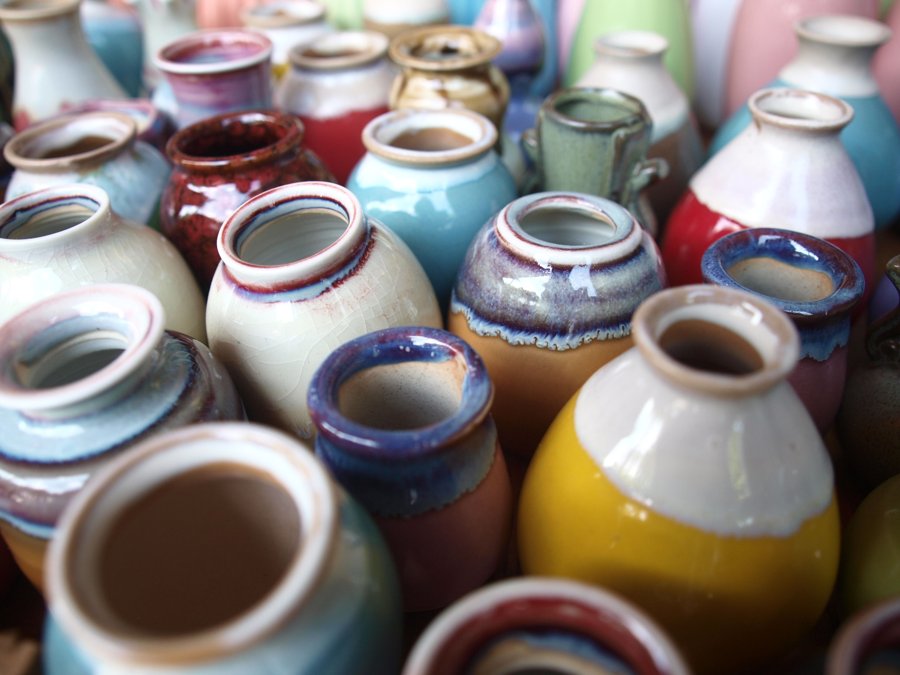
A glaze is typically applied to unfired or once-fired (bisque) ware as a wet suspension, then allowed to dry before the piece goes into the kiln. During firing, the glaze materials melt into a glass, matching (ideally) the clay body's own expansion and contraction as both cool. See glaze chemistry for how that recipe is actually understood and formulated in terms of its oxide content, rather than as an opaque list of raw materials.
¶ Composition
Every glaze recipe, whatever else it contains, is built around three functional roles: a glass former, almost always silica, which is the actual glass-forming material; one or more fluxes (see feldspars & fluxes), which lower silica's otherwise impractically high melting point into a reachable range; and a stabilizer, almost always alumina, contributed by clay or feldspar, which thickens the melt enough to keep it from running off the piece during firing. Glaze chemistry covers how potters actually reason about these three roles using a recipe's oxide breakdown; this section covers what physically supplies them.
Beyond that structural core, a recipe typically adds colorants (metal oxides that tint the glass) and sometimes opacifiers (materials that scatter light rather than letting it pass through, hiding the body underneath). Some recipes use raw minerals directly; others use a frit, a pre-melted batch of glass that has already been fused and then quenched and ground back into a powder, most notably as the standard way to make lead usable in a glaze at all (see Health and safety below).
¶ Colorants and opacifiers
Most glaze color comes from metal oxides, several of which behave very differently depending on firing atmosphere as well as chemistry:
See atmospheres for the underlying chemistry of why iron and copper in particular respond so strongly to oxidation versus reduction.
¶ Surface qualities
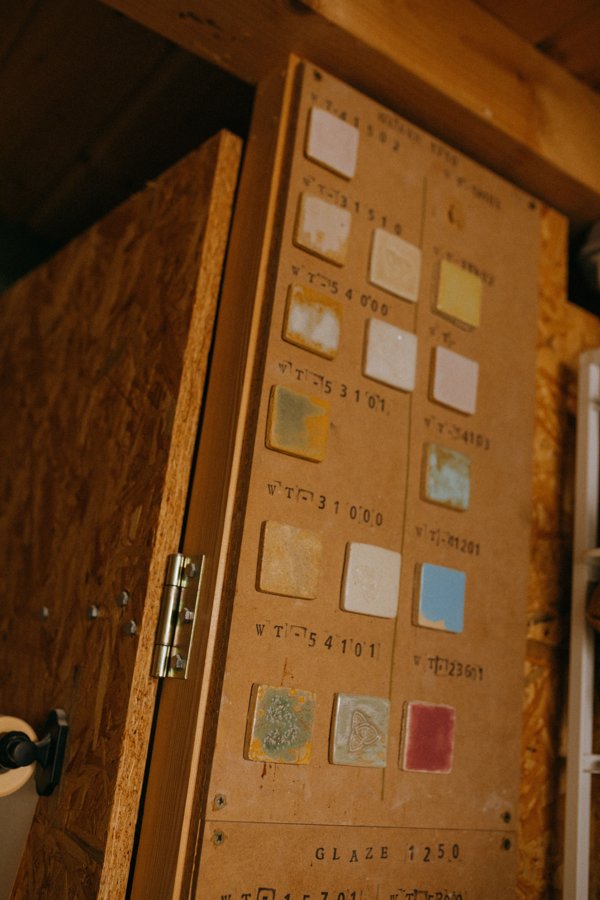
Glazes are commonly grouped by how they leave a surface, independent of color. A glossy glaze is smooth and highly reflective; a matte glaze has a dull, low-reflectance surface, either from a chemistry that does not form a fully smooth glass (a true matte) or from tiny crystal growth during cooling that scatters light (a crystalline matte); a satin glaze sits between the two. Transparent glazes let the clay body or an underlying decoration show through, while opaque glazes hide the body underneath entirely. Crystalline glazes push crystal growth further still, deliberately growing large, visible crystal clusters within the glaze layer as the main decorative effect rather than a side note, usually requiring a slow, carefully controlled cooling cycle to give the crystals time to form.
¶ Decoration timing: underglaze, in-glaze, and overglaze
Where a decoration sits relative to the glaze layer, not just what technique applied it, is its own axis of classification, distinct from the application methods below.
Underglaze decoration is applied to the bare bisque surface before any glaze goes on, so the finished glaze layer sits on top of and protects it; classic cobalt blue-and-white ware is painted this way. In-glaze decoration is painted directly onto an already-applied, still-raw (unfired) glaze layer, so the pigment and the glaze melt and fuse together in a single firing; traditional maiolica and faience painting works this way, which is part of why the brushwork on historical maiolica often looks soft-edged rather than crisp, since the colors bleed slightly into the glaze as both melt together. Overglaze (also called on-glaze or enamel) decoration is applied on top of a glaze that has already been fired, then fired again, at a distinctly lower temperature, just to fuse the decoration onto the already-glassy surface without re-melting the glaze itself. Overglaze enamels can reach colors (certain reds and golds in particular) that cannot survive a full glaze-firing temperature at all, at the cost of durability, since the decoration sits on the surface rather than being protected under or fused into the glaze layer; it wears with use in a way underglaze decoration does not. Combining more than one of these in sequence on a single piece, most famously in Japanese Imari ware (underglaze cobalt blue, then overglaze red and gold enamels added in a second firing), is a long-standing decorative tradition in its own right.
¶ Application
A glaze is typically applied by dipping, pouring, spraying, or brushing, the four standard methods, each suited to different work: dipping and pouring for fast, even whole-piece coverage; spraying for gradients, layering, and awkward shapes; brushing for detail work, small pieces, and touch-ups. See each technique's own article for how it actually works and how thick a glaze needs to be mixed for it. Whatever the method, the point where a piece was held, and any foot or base that needs to stay bare to avoid fusing to a kiln shelf, generally needs cleaning up by hand afterward (see kiln types for kiln furniture and kiln wash, the other side of that same problem).
¶ Firing
The glaze layer does the bulk of its work during the firing itself, not during application. As the kiln climbs through the glaze's melting range, the raw materials fuse into a continuous glass and chemically bond to the clay body's own surface; the specific point this happens depends on the recipe's chemistry and is tracked with pyrometric cones rather than a thermometer reading alone, since cones measure the cumulative heat-work a firing actually delivered. As the kiln cools, a properly formulated, properly fired glaze "heals" over small surface irregularities and sets as a smooth, scratch-resistant glass layer; see crazing, shivering, crawling, and pinholing & blistering for what happens when that process goes wrong at various stages. Kiln type and atmosphere, oxidizing or reducing, both change what a given recipe actually looks like once fired, independent of the recipe itself.
¶ Health and safety
Some traditional glaze ingredients are genuinely hazardous if mishandled. Lead, historically valued as an effective, low-temperature flux, is a potent neurotoxin; a lead glaze that is improperly formulated or underfired can leach lead into food or drink, especially from acidic contents like citrus or tomato, which is the specific reason raw (unfritted) lead glazes are avoided entirely on functional ware today. Fritting lead (see Composition above) substantially reduces this risk compared to using it raw, but does not eliminate the need for proper formulation and firing. Cadmium, used for certain bright reds and oranges, carries similar leaching concerns and its own toxicity profile. Barium carbonate, used for some matte effects and colors, is hazardous if ingested in raw form, though it becomes far less soluble once properly fused into a fired glaze; strontium carbonate is a common, less hazardous substitute in many recipes that historically used barium. Chromium, in its Cr(VI) form that can develop under some firing conditions, is a separate environmental and health concern from the Cr(III) form the raw colorant usually starts as. Commercially tested, food-safe glazes exist specifically to remove this guesswork for functional ware; see environmental impact for the broader material-safety picture (dust, kiln emissions, studio waste) this fits into beyond glaze chemistry specifically.
¶ History
The earliest known glazed material is Egyptian faience, a self-glazing, quartz-based substance developed in Egypt and Mesopotamia by around 4000 BCE. Faience is not a clay body, so it is technically distinct from glazed pottery, but it established the same basic chemistry, silica fused with an alkali flux into a glassy surface, that pottery glazes would later use. After the development of glassmaking around 1500 BCE, alkaline glazes made from soda ash or plant ash spread through Egypt and the Middle East, while high-fired stoneware glazes developed independently in China: proto-celadon glazes appear on stoneware from the Shang dynasty (1600–1046 BCE), among the earliest true glazes applied to an actual clay body rather than a glass-like coating on a non-clay material. Chinese glaze technology continued to develop through later dynasties, eventually refining the celadon and copper-red effects that depend on firing in a reducing atmosphere.
Lead as a glaze flux emerged later and spread widely. Lead-glazed earthenware appears in China by the Warring States period (475–221 BCE) and expanded under the Han dynasty, and lead-glazing was in wide use across the Old World by around 100 BCE. A separate, later innovation, tin-opacified glaze (a lead glaze made opaque white by adding tin oxide), first appears in Basra in the 8th century CE, part of a wave of Islamic ceramic innovation that also produced luster ware and spread through centers including Fustat, Damascus, and Tabriz. Tin-glaze technology eventually reached Europe through Islamic Spain, developing into Hispano-Moresque ware, then Italian maiolica, French and Dutch faience, and Delftware, the tradition that made in-glaze painting (see Decoration timing above) a defining decorative technique across several centuries of European pottery.
Glaze chemistry did not become a rigorous, quantitative science until the late 19th century. German ceramicist Hermann Seger (1839–1893), director of the chemical-technical experiment station at Berlin's Royal Porcelain Factory from 1878, proposed describing a glaze by its oxide composition in mole percent rather than as a list of raw materials: the same unity formula still used to formulate and analyze glazes today. Seger's 1886 work on standardized pyrometric cones gave potters a physical way to measure heat-work directly rather than relying on a kiln thermometer's peak reading alone. Much of what modern glaze chemistry treats as basic vocabulary, describing a recipe in terms of flux, stabilizer, and glass-former oxides rather than a list of raw ingredients, traces directly back to Seger's work.
¶ References
- Zhiyan, Li (2002). Chinese Ceramics: From the Paleolithic Period through the Qing Dynasty. Yale University Press / Foreign Languages Press. pp. 144–152. Primary source for Shang-dynasty proto-celadon, found via Wikipedia's own citation. worldcat.org
- Craddock, Paul T. (2009). Scientific Investigation of Copies, Fakes and Forgeries. Routledge. p. 207. Primary source for lead-glazing's spread across the Old World by ~100 BCE, found via Wikipedia's own citation. worldcat.org
- Seger, Hermann August (1902). The Collected Writings of Hermann August Seger. Easton, PA: American Ceramic Society and Chemical Publishing Company. Seger's own writings, the primary source behind the unity formula and pyrometric cones. catalog.hathitrust.org
- Verhelst, Paul (2018). "Stone that Flows." Expedition Magazine 60(3). University of Pennsylvania Museum of Archaeology and Anthropology. Source for Egyptian faience's ~4000 BCE date, found via independent search rather than through Wikipedia's own citation trail (which left this claim uncited). penn.museum
- Wikipedia contributors. Ceramic glaze. Wikipedia, The Free Encyclopedia. Still the source for the Basra tin-glaze date, which Wikipedia's own article leaves uncited. en.wikipedia.org
- Wikipedia contributors. Hermann Seger. Wikipedia, The Free Encyclopedia. Still the source for Seger's 1878 KPM appointment, which Wikipedia's own article leaves uncited. en.wikipedia.org
- Photo by mingche lee, via Pexels, Pexels License (resized and re-compressed from the original).
- Photo by KoolShooters, via Pexels, Pexels License (resized and re-compressed from the original).