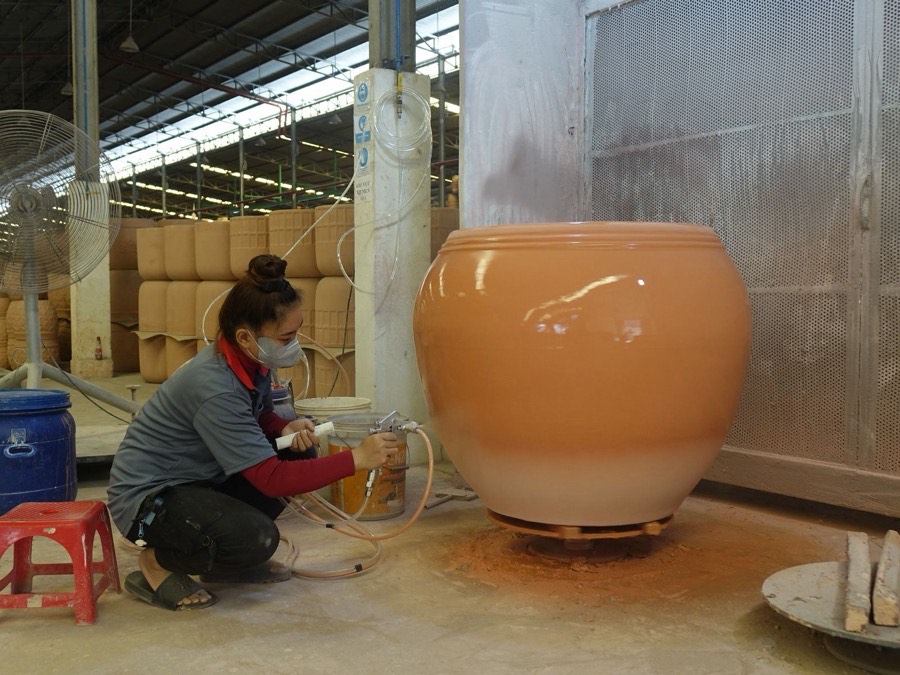
Spraying is a glaze application technique in which glaze, thinned to a workable consistency, is applied through a spray gun or airbrush driven by an air compressor, building up an even coating in light, layered passes rather than one single application.
¶ How it works
Because a sprayer only deposits a thin mist per pass, an even coating is built up gradually over several overlapping passes rather than in one motion, giving finer control over thickness than dipping or pouring allow. A glaze mixed for dipping is generally too thick to spray at all; spraying glazes are thinned further, often down to somewhere around 1.30 to 1.40 specific gravity, so the mixture can actually atomize through the gun instead of clogging or spitting. That same layering makes spraying the standard way to blend two or more glazes into a gradient across a single surface, or to build up multiple thin, overlapping glaze layers with sharp control over exactly where each one starts and stops. It also reaches large or irregularly shaped pieces that would be impractical to dip or awkward to pour evenly.
¶ Practical considerations
Spraying puts fine glaze particles into the air, including whatever crystalline silica or other hazardous materials the glaze recipe contains, which makes proper ventilation, a dedicated spray booth, and respiratory protection a real requirement rather than a nice-to-have; see environmental impact for the broader material-safety picture this fits into, including OSHA's own published exposure limits for the silica dust risk specifically. Spraying equipment and setup (a compressor, a spray booth, cleanup between glazes to avoid contamination) also represent more overhead than the other application methods, which is part of why it tends to show up more in production and studio settings than for a single one-off piece.
Spray guns come in two main feed types. A gravity-feed gun holds its glaze cup above the nozzle and needs less air pressure to atomize the mixture, giving finer control and less overspray, which is why it's the more common studio choice. A siphon-feed (or suction-feed) gun draws glaze up from a cup below the nozzle using the air stream itself, needing more pressure to work but tolerating a larger reservoir. Either style will glaze ceramic ware adequately; the choice mostly comes down to control and reservoir size rather than one being fundamentally unsuited to the job.
¶ References
- Hansen, Tony. "Spray Glazing." Digitalfire Reference Library. digitalfire.com
- Photo by Vyvan BÙI VY VÂN, via Pexels, Pexels License (resized and re-compressed from the original).