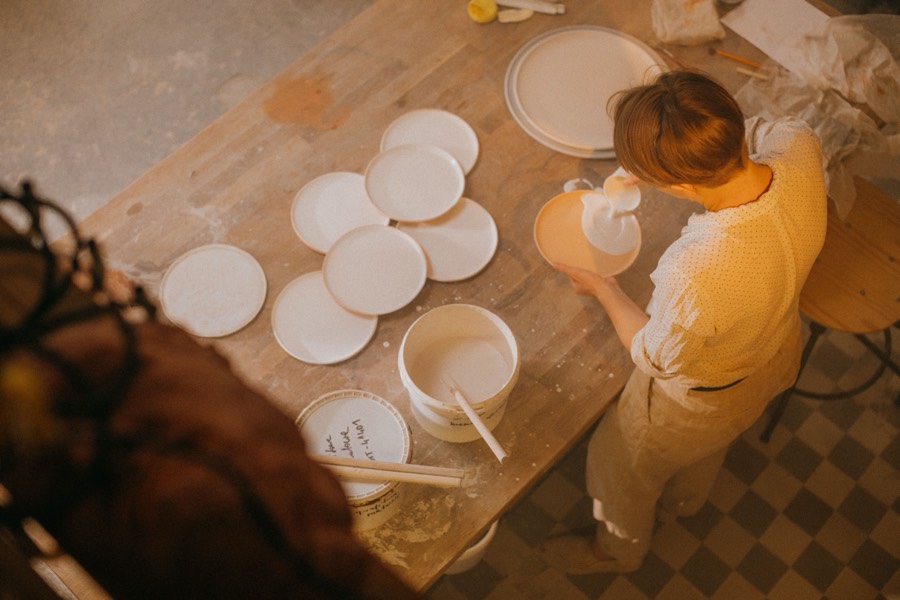
Dipping is a glaze application technique in which a piece is submerged in a bucket of glaze, held for a few seconds, then withdrawn in one continuous motion, leaving an even coating over whatever surface went under. It is the standard method for coating a whole piece quickly and consistently, and the usual choice for production work where many similar pieces need the same coverage.
¶ How it works
A piece is typically held by an unglazed foot or gripped with tongs, lowered into a glaze bucket sized to submerge the whole piece (or the whole area meant to be glazed) in a single motion, then lifted straight back out. Coating thickness depends mainly on the glaze's specific gravity (how thick the suspension is) and how long the piece stays submerged; both are adjusted to hit a target thickness rather than relying on visual judgment mid-dip. The point where the piece was held, or where a bare foot needed to stay glaze-free, usually needs cleaning up or touching up by hand afterward.
Specific gravity (the weight of the glaze suspension relative to an equal volume of water) is the standard way potters measure and adjust glaze consistency before dipping, usually with a hydrometer or by weighing a fixed volume. A typical dipping glaze runs somewhere around 1.40 to 1.50, thick enough to build a workable coating in a few seconds' submersion without needing an impractically long dip. Too thin, and even a long dip leaves the coating too thin to melt properly; too thick, and a short dip already lays down more glaze than the piece can hold without cracking or crawling once dry. Water is added to thin a glaze that has settled or thickened over time, and the bucket is stirred before use since glaze solids settle out of suspension when left standing.
¶ Practical considerations
Dipping needs a glaze bucket large and deep enough to submerge the piece, which makes it impractical for very large work or for pieces with awkward shapes that trap air pockets or drips in ways that leave the coating uneven. It is also an efficient way to apply glaze evenly to interiors and undersides in a single motion, which pouring and spraying both handle less directly. Glaze applied too thick from an over-long dip is a common contributor to crawling, so dip time is usually tuned by test tile rather than guessed.
¶ References
- Hansen, Tony. "Specific Gravity." Digitalfire Reference Library. digitalfire.com
- Photo by KoolShooters, via Pexels, Pexels License (resized and re-compressed from the original).