Slip trailing is a decoration technique in which slip is applied by drawing directly onto a piece, squeezed from a narrow-tipped applicator the way icing is piped onto a cake, building up a raised, drawn line rather than removing any material the way sgraffito does. It is one of the oldest known ceramic decoration techniques, long associated with traditional English and European slipware.
The technique's best-documented historical showcase is Staffordshire slipware from Burslem, England, in the late 17th century, particularly the elaborately trailed presentation dishes attributed to the Toft family of potters (Thomas Toft the most prominent among them, active roughly 1671–1689). Their large earthenware chargers, trailed in multiple colors of slip with mermaids, coats of arms, and figures within cross-hatched borders, are still cited as the high-water mark of trailed slipware decoration.
¶ How it works
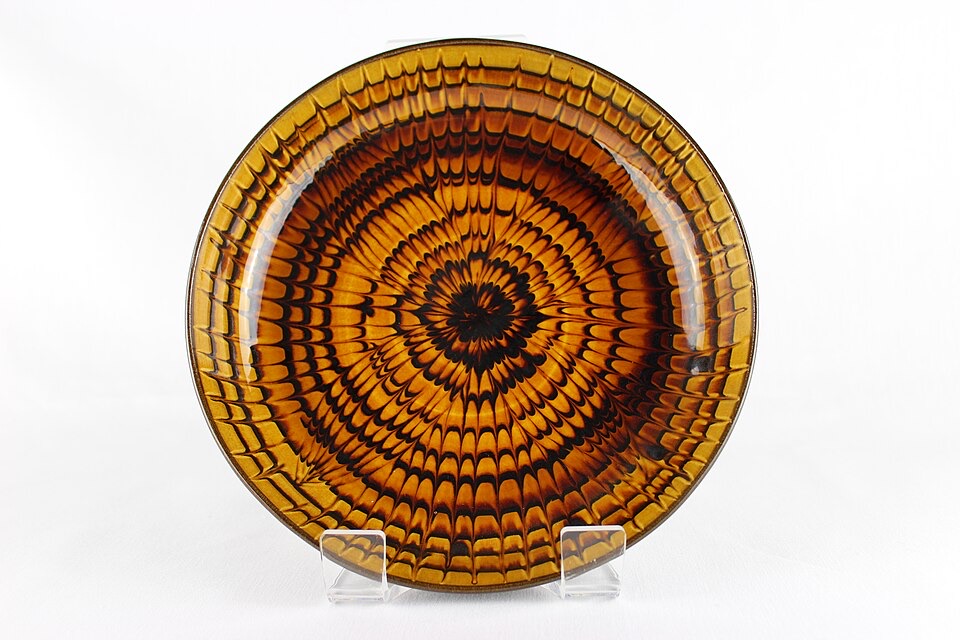
Slip, thinned to a smooth, pourable consistency, is loaded into a slip trailer, historically a bulb-shaped applicator with a narrow nozzle, functionally similar to the tools used for cake icing or resist work in other crafts. The applicator is squeezed gently while moved across the piece's surface, laying down a continuous bead of slip that dries proud of the surrounding surface rather than flush with it, giving trailed decoration a distinct raised, drawn quality unlike a painted or brushed line. Multiple colors of slip can be trailed in sequence, and a technique called feathering, dragging a fine point across still-wet trailed lines of two different colors, pulls them into a marbled, feathered pattern rather than leaving each line separate.
¶ Practical considerations
The slip needs to be mixed to a specific consistency for trailing: too thin, and it runs and loses the crisp raised line; too thick, and it clogs the applicator's narrow tip or drags rather than flowing smoothly. Trailed slip is normally applied to a piece still wet or leather-hard rather than fully dry, since the trailed slip and the body beneath it need to dry together at a compatible rate to avoid the raised line cracking or lifting away from the surface as both dry and shrink.
¶ References
- Hansen, Tony. "Slip Trailing." Digitalfire Reference Library. digitalfire.com
- "Thomas Toft." Wikipedia. en.wikipedia.org
- Photo of "Thrown, Slip Trailed, Feathered Dish by Joan Hotchin" (York Museums Trust, W.A. Ismay Studio Ceramics Collection), via Wikimedia Commons, licensed CC BY-SA 3.0 (resized and re-compressed from the original).
.JPG)