Sgraffito (from the Italian sgraffiare, "to scratch") is a decoration technique in which a layer of slip is applied over a clay body of a contrasting color, then scratched through with a pointed tool to reveal the body color beneath in whatever pattern was cut. While the Italian name comes from Renaissance decorative arts, where sgraffito was used on both pottery and architectural wall decoration, the scratch-through technique itself is far older and considerably more widespread: Etruscan and Roman potters practiced it, Islamic potters across the medieval Middle East made it common, and incised surface decoration on damp clay predates any of these by millennia.
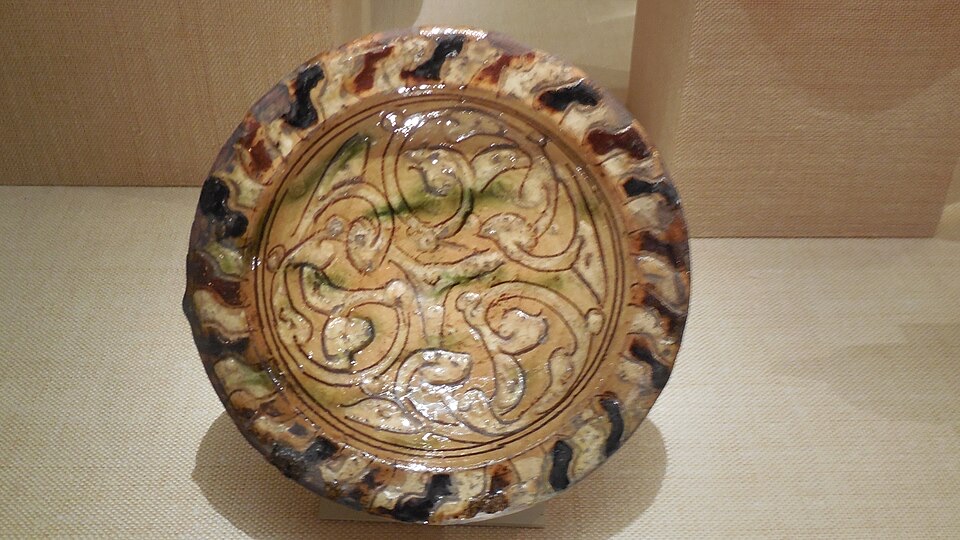
¶ How it works
A leather-hard piece is coated with a slip whose fired color contrasts clearly with the clay body's own color, most commonly a light slip over a dark body or the reverse, and left to firm up slightly so the slip holds together without crumbling once cut. A pointed or angled tool is then used to scratch or carve through the slip layer, removing it in the cut lines and exposing the body color directly beneath in a clean, high-contrast line. Broad areas can be scraped away entirely for a bolder effect, or fine, closely spaced lines can build up shading and detail the way engraving does.
¶ Practical considerations
Timing the cut matters: too wet, and the slip smears rather than cutting cleanly; too dry, and it chips or flakes unpredictably instead of scratching in a controlled line. The slip layer needs to be thick enough to fully expose the contrasting body color when cut through, but not so thick that it is prone to cracking or flaking off on its own before the piece is even decorated. Sgraffito is usually done on bare clay before any glaze, with a transparent or lightly tinted glaze applied afterward to protect the finished surface without hiding the contrast the technique was built to show.
¶ Wet sgraffito vs. hard sgraffito
The leather-hard method described above, sometimes called wet sgraffito, is the traditional approach and the one most beginners learn first. A second variant, hard sgraffito, is done on already-bisqued ware instead: underglaze is painted onto the bisque surface (slip's higher water content isn't suited to a porous, already-fired body the way it is to raw clay) and scratched through once dry, exposing the bare bisque beneath rather than the wet clay body. The two variants produce a broadly similar high-contrast line but differ in exactly when in the making process the decoration happens and which material, slip or underglaze, gets cut through.
¶ References
- Encyclopaedia Britannica. "Sgraffito." britannica.com
- Photo of "Sgraffito-ware" Bowl, Mamluk period, 14th century, via Wikimedia Commons (Metropolitan Museum of Art), public domain (resized and re-compressed from the original).
