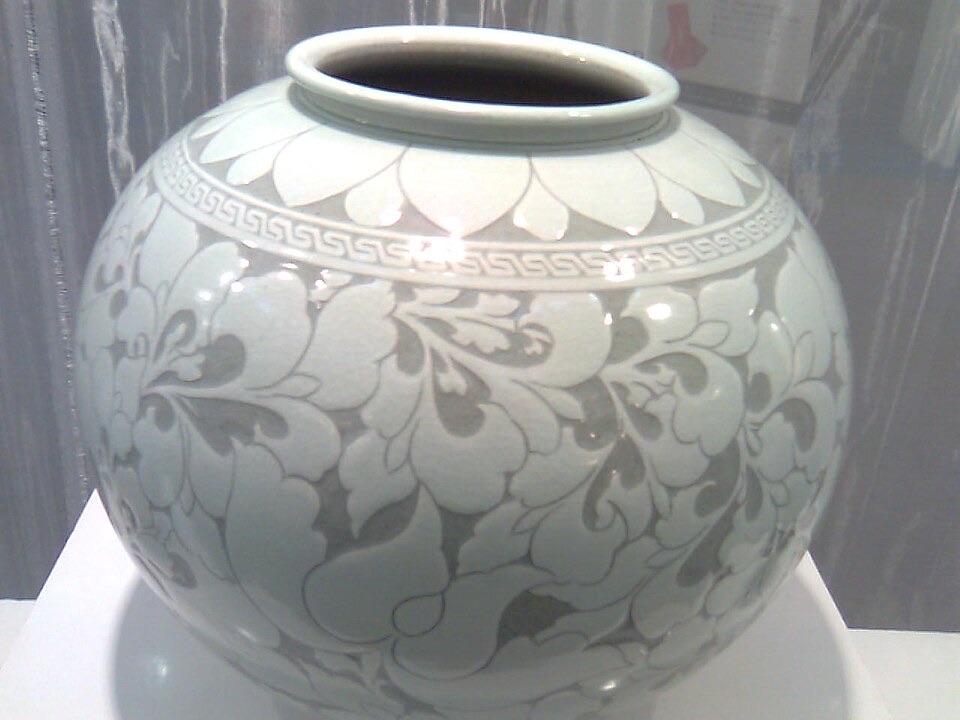
Mishima is a decoration technique in which a pattern is carved or stamped into a leather-hard piece, filled with a contrasting slip, and then scraped level once firm so the inlay shows cleanly only within the carved or stamped lines. Unlike sgraffito, which removes a top layer of slip to reveal the clay beneath, mishima adds slip into recesses cut into the clay itself. The technique traces to Korean buncheong ware of the early Joseon dynasty (15th century), itself developed from an earlier Goryeo-dynasty celadon inlay technique called sanggam; as buncheong production declined in Korea in favor of porcelain, related stoneware carrying the same slip-inlay aesthetic continued in Japan, where it became known as Mishima, a name associated with the Mishima Shrine in Shizuoka.
¶ How it works
A design is carved with a pointed tool or pressed in with a stamp into a leather-hard piece, cutting or impressing a network of fine lines or small recesses below the surrounding surface. A slip of a contrasting color, usually thinned to a fluid, easily brushed consistency, is applied generously over the whole decorated area, filling the carved or stamped recesses along with the surrounding surface. Once the slip has firmed up somewhat, the excess is scraped away from the surrounding flat surface with a rib or similar tool, leaving slip only where it settled into the recesses below the surface, so the pattern reads as a crisp, contrasting line or shape against the body's own color.
¶ Practical considerations
Getting a clean result depends on the timing of the scrape: too soon, and the still-soft inlaid slip smears or pulls back out of the recesses along with the excess; too late, and the surrounding slip has bonded too firmly to scrape away cleanly without also disturbing the inlay. Carved or stamped lines that are too shallow hold too little slip to read clearly once scraped, while very fine detail can be difficult to fill completely without leaving air gaps. As with sgraffito, mishima is normally done on bare clay before glazing, with a transparent or lightly tinted glaze applied afterward to protect the finished surface.
In Japan, the same general technique is also called zōgan, and the two names aren't always used identically: zōgan is the broader Japanese term for inlay work of this kind, while "mishima" more specifically evokes the repeated stamped patterns characteristic of the ware the name originally described. In practice, contemporary studio potters and instructional writing often use the two terms interchangeably, or simply describe the technique in English as slip inlay.
¶ References
- The Metropolitan Museum of Art. Korean Buncheong Ceramics from Leeum, Samsung Museum of Art. resources.metmuseum.org
- Photo by Taman Renyah, "Buncheong Ceramic," via Wikimedia Commons, licensed CC BY 3.0 (resized and re-compressed from the original).
