Carving is a decoration technique in which a pattern, texture, or relief is cut directly into a clay body, without adding any slip or other material the way sgraffito and mishima both do. It ranges from shallow incised line work to deep relief carving that removes substantial material to leave a raised design standing proud of the surrounding surface.
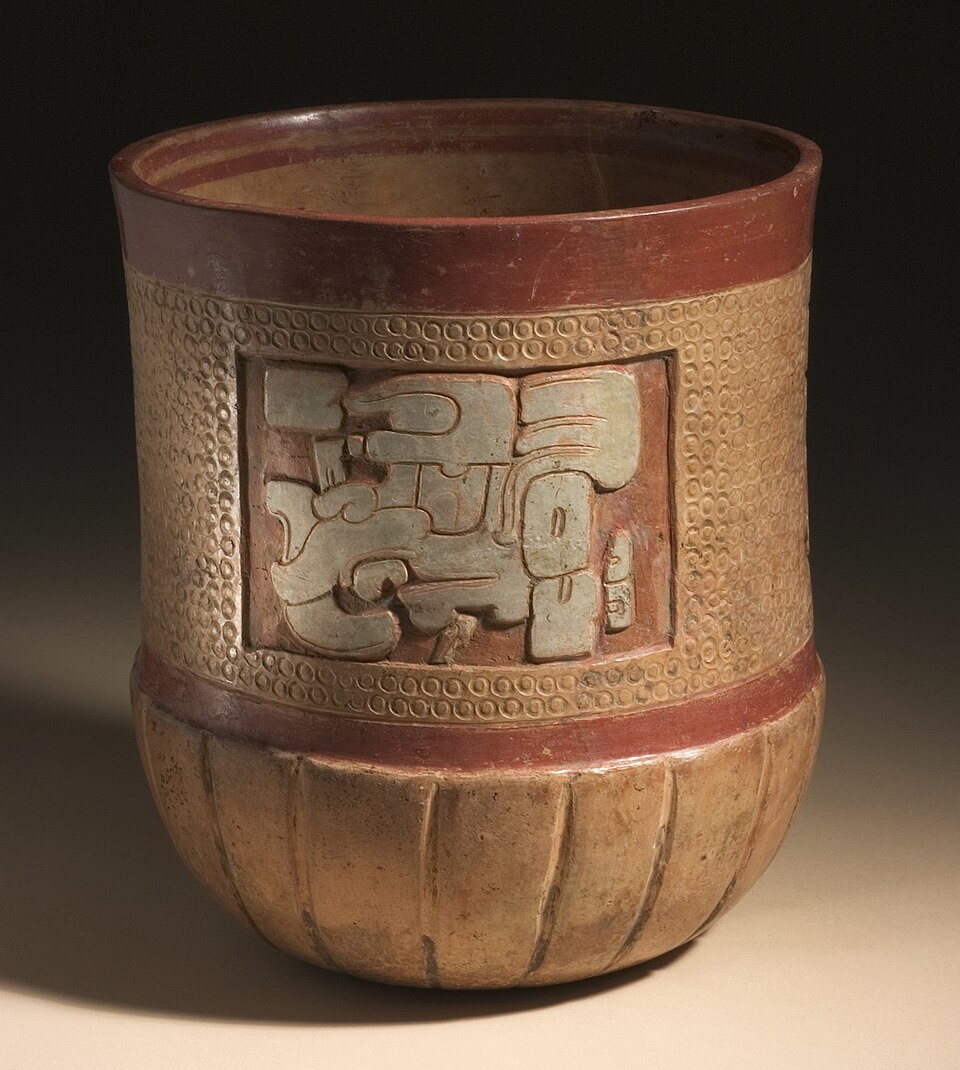
¶ How it works
Carving is generally done at leather-hard, when the clay is firm enough to hold a crisp cut edge but still soft enough to cut without chipping or cracking, the same working window trimming uses for the same reason. Simple incised line work uses a pointed or V-shaped tool to cut a groove of a consistent depth, while true relief carving removes background material around a design with a loop or gouge tool, leaving the design itself standing higher than the newly lowered surrounding surface. Deeper relief carving removes considerably more clay and needs a correspondingly thicker wall to carve into without cutting through it.
The tool shape matters for the result: a loop tool, a wire loop bent into a rounded or U-shaped profile, scoops out material smoothly and suits hollowing and broad relief removal, while a narrower, sharper ribbon tool cuts cleaner, more precise lines and fine detail. Carving is distinct from faceting, a related but separate altering technique that cuts flat planes into a still-round thrown form with a wire or blade; faceting reshapes the piece's overall form, while carving only decorates a surface that keeps its underlying shape.
¶ Practical considerations
A wall meant for deep relief carving is usually thrown or built thicker than one that will stay plain, since carving removes material that a thin wall cannot spare without risking a hole straight through. As with other leather-hard decoration techniques, carving too early risks distorting a still-soft form under the tool's pressure, while carving too late (closer to bone-dry) risks the clay chipping or crumbling rather than cutting cleanly. Carved texture and relief also affect how a glaze settles once applied: glaze tends to pool more thickly in recessed carved lines and run thinner over raised areas, which can be used deliberately to accent a carved pattern once fired.
¶ References
- Photo of "Carved and Incised Vessel with Deity Heads" (LACMA), via Wikimedia Commons, public domain (resized and re-compressed from the original).
