Burnishing is a decoration technique in which a piece's bare clay surface is polished to a smooth, soft sheen by rubbing it firmly with a hard, smooth tool, without adding glaze or any other material. It is one of the oldest surface treatments in pottery, long predating glaze technology, and remains closely associated with traditional low-fire and pit-fired ware, including much traditional terracotta.
¶ How it works
A piece is burnished at leather-hard, worked over its whole surface with a smooth, hard tool, traditionally a river stone, a piece of bone or antler, or a smooth metal spoon, pressed firmly and rubbed in overlapping strokes. The pressure compacts and aligns the clay particles at the very surface into a dense, smooth layer, which is what produces the sheen, distinct from the matte, granular surface of unburnished bare clay. A well-burnished surface can approach a soft, low gloss without any glaze at all, though it is a duller, warmer sheen than a true glaze's glassy shine.
¶ Practical considerations
Burnished ware is normally left unglazed and fired at low temperature, often in a pit or bonfire firing, since a burnished surface is largely undone by glazing over it, and higher firing temperatures can also flatten or disrupt the compacted surface layer the burnishing created. Because it adds no glass layer, burnished ware stays more porous than a glazed piece and is not considered food-safe or watertight the way a properly glazed functional piece is, which is part of why burnishing is more closely associated with decorative and ceremonial ware than everyday functional pottery. Burnishing quality depends heavily on getting the clay's moisture right at the time of burnishing: too wet, and the tool drags and tears the surface rather than compacting it; too dry, and there is not enough give left in the clay for the tool to actually smooth and align the surface particles.
¶ References
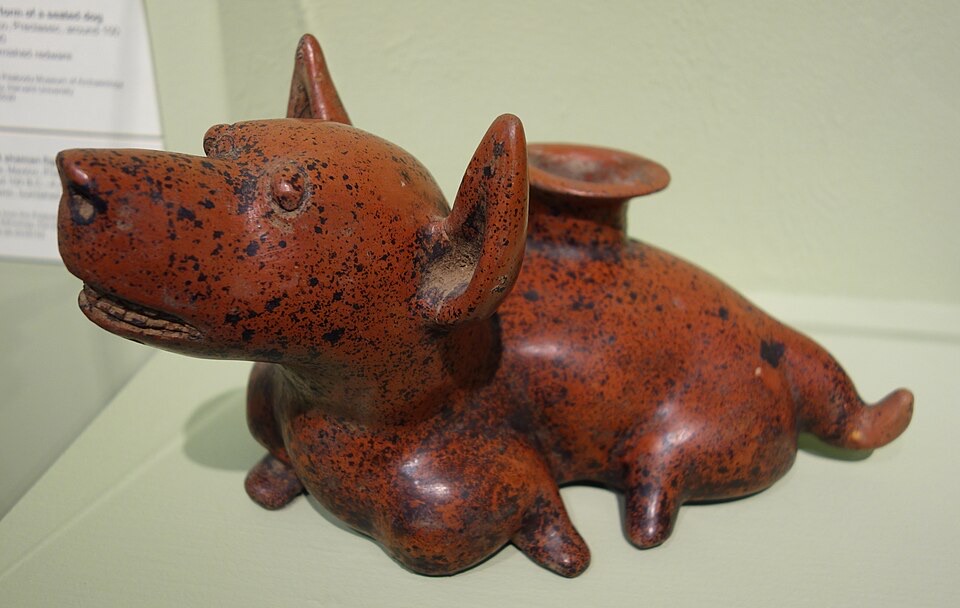
- Photo of "Vessel in the form of a seated dog" (Colima, Mexico, Preclassic, ceramic, burnished redware — Fitchburg Art Museum), via Wikimedia Commons, CC0 (resized and re-compressed from the original).
