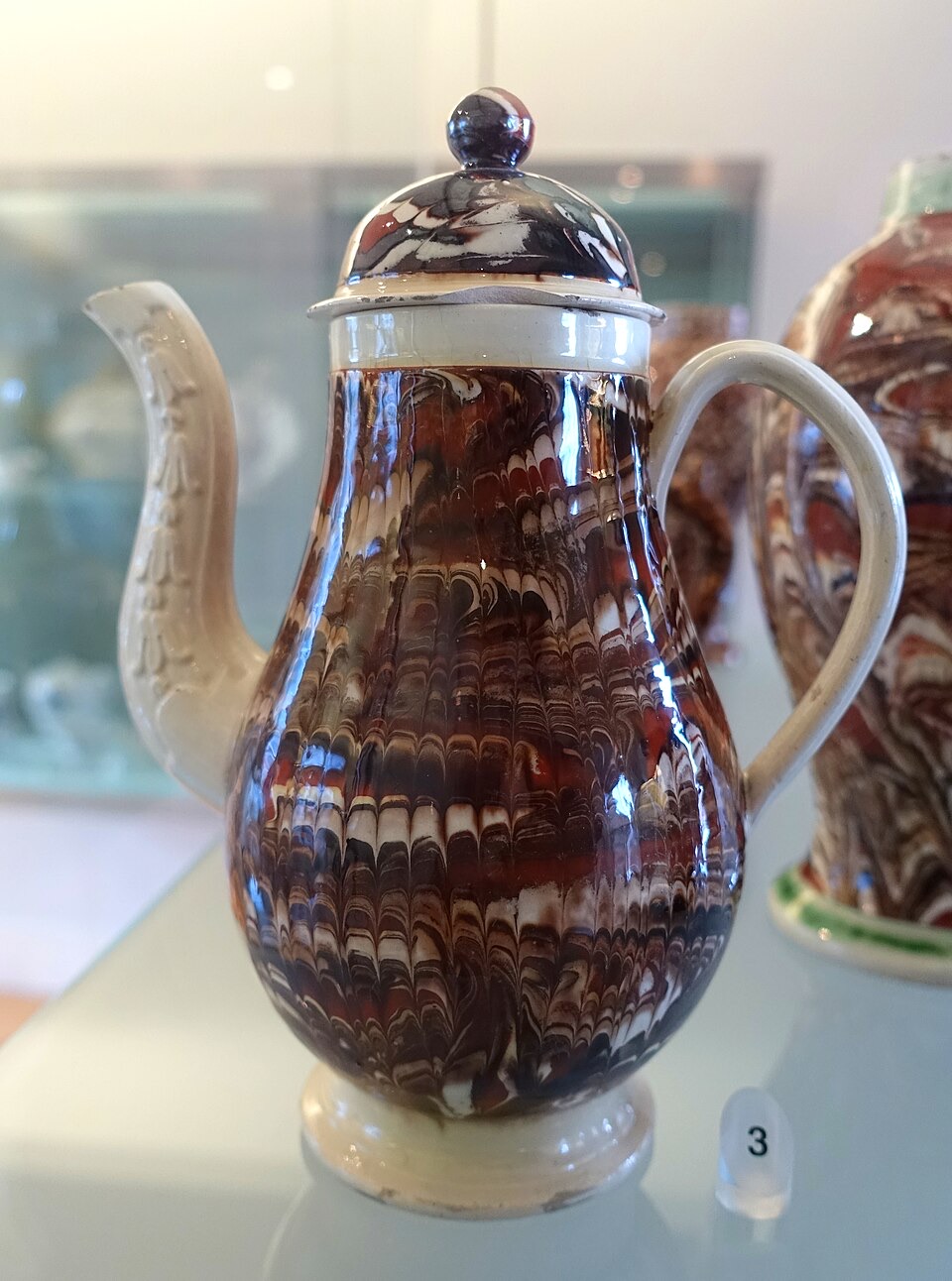
Agateware is a decoration technique in which two or more different-colored clay bodies are partially blended together before forming, producing a marbled, layered pattern that runs through the material itself rather than sitting on its surface. The name comes from its visual resemblance to banded agate stone. English agateware is generally dated to around 1730, credited to Dr. Thomas Wedgwood of Rowley's Pottery in Burslem, Staffordshire, and is thought to have been inspired partly by Chinese marbled wares already circulating in English collectors' cabinets of curiosities. Potter Thomas Whieldon significantly refined the technique in the 1740s, using white clays stained with metallic oxides layered together for a more controlled marbling effect; solid agateware was mostly a mid-18th-century phenomenon, largely fading out by around 1760, though Josiah Wedgwood later revived aspects of the technique for surface ornamentation on other bodies.
¶ How it works
Two or more clay bodies of different, usually naturally occurring, colors are wedged together only partially, enough to layer and streak them against each other without fully mixing into a single uniform color, the same distinction that separates marbling from simply blending two clays into a new, third body color. The partially blended clay is then formed by whatever method suits the piece, wheel throwing, slab building, or press molding all work, and the marbled pattern carries through the wall thickness rather than being confined to the surface, so it remains visible even if the surface is later carved, trimmed, or worn.
¶ Practical considerations
The clay bodies used together need closely matched shrinkage and thermal expansion, since two bodies that shrink or expand at meaningfully different rates through drying and firing tend to crack or separate along the boundary between them as they move against each other. Over-wedging is the most common way agateware goes wrong: enough mixing to fully blend the colors into a uniform tone loses the marbled pattern the technique is built around, so wedging is deliberately kept incomplete and stopped well short of a fully even blend. Because the pattern is genuinely three-dimensional, agateware also handles trimming and carving differently than a piece merely decorated on the surface, since cutting into an agateware wall reveals more of the internal pattern rather than removing the decoration.
American folk pottery developed its own parallel tradition under a different name, scroddled ware (the U.S. Pottery Company in Bennington, Vermont, marketed its 19th-century version as "Lava"). The best-known American example came later: Niloak Pottery of Benton, Arkansas (the name is "kaolin" spelled backward), patented a wheel-thrown swirled-clay line called Mission Ware in 1928, blending Arkansas clays in blue, red, white, gray, brown, and beige on the wheel itself rather than only marbling the raw material beforehand.
¶ References
- Encyclopaedia Britannica. "Agateware." britannica.com
- "Niloak Pottery Vase." National Museum of American History. americanhistory.si.edu
- Photo by Daderot, "Coffee pot, c. 1790-1860, marbleware" (Museu Nacional de Soares dos Reis), via Wikimedia Commons, CC0 (resized and re-compressed from the original).
